
Cosmetic Bottle Closures Explained: Liners, Wadded vs Unwadded & Leak Prevention

Most brands obsess over the bottle, the pump, and the label, then treat the cap liner as an afterthought. That tiny disc inside the closure is the difference between a shipment that arrives clean and a palette of leaky, oxidized, customer-returned stock. A cap liner (also called an insert, wad, or gasket) is the material seated inside the cap that presses against the top of the bottle or jar when you tighten it. Get the liner wrong and low-viscosity oils creep through the threads, foams swell, and caps loosen in transit.
This guide covers the two liner families: wadded versus un-wadded. It shows which material to pair with which formula, why the wrong liner leaks, and how closure choice connects to neck finish and export shipping. We keep Venturove-specific claims out of it and point you to the right place to confirm options.
Key Takeaways
Cap liners seal the bottle opening against the cap, blocking leaks, air, and contamination. The liner code (F217, TE, PS) must be specified explicitly, not just “standard liner.”
Wadded liners are compressible foam or pulp discs (F217 foam is the typical example). They cushion and reseal well, making them the default for water-based lotions and personal care, but they swell under essential oils and solvents.
Un-wadded liners are thin film or foil laminates: induction foil gives a hermetic, tamper-evident seal but needs sealing equipment; pressure-sensitive (PS) needs no equipment but offers weaker leak protection.
Match the liner to the formula, not the catalog: oil-based creams take F217 or foil, essential oils need a solvent-resistant or PTFE-faced liner, and antioxidant serums need a low-oxygen-transmission foil.
Leaks usually start from capillary migration of low-viscosity oils, cap-torque loss under thermal cycling, or plastic-jar creep. Verify the seal after accelerated aging, not on day one.
The closure must match the bottle neck finish (for example 24/410). Tighter deep-helix threads convert torque into uniform compression for better seals on volatile products.
What a Cap Liner Actually Does
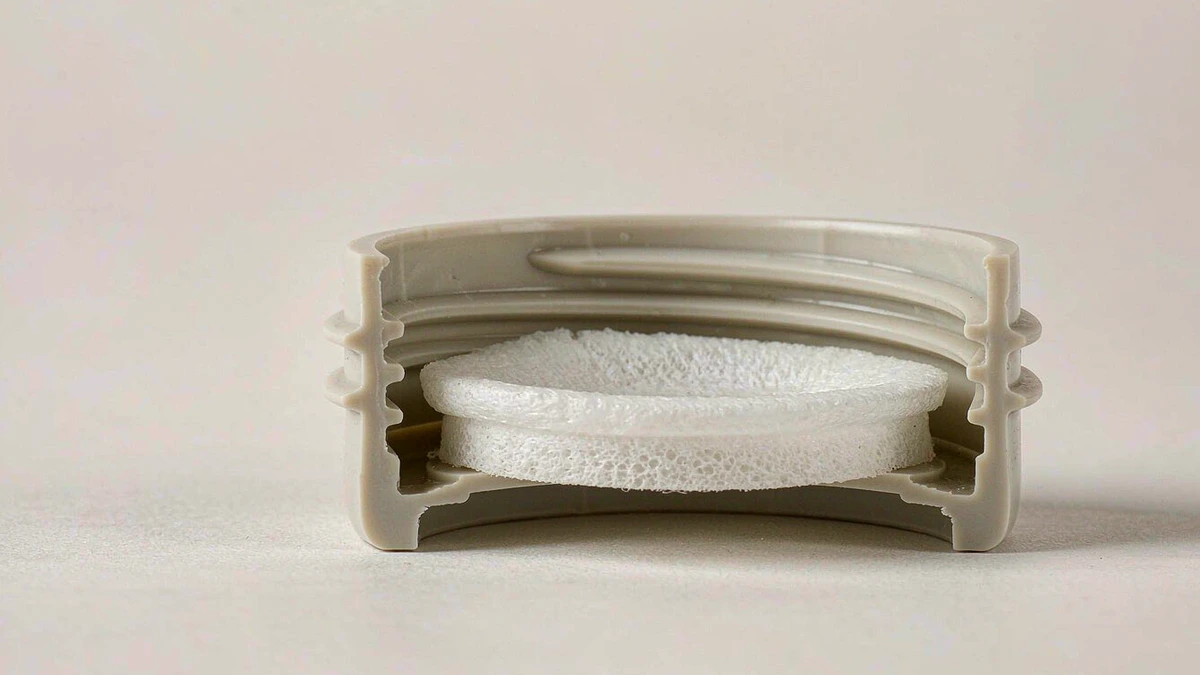
A liner is a disc inside the cap that seals against the bottle’s top surface, called the finish or land area, when the cap is torqued down. Its jobs are simple but non-negotiable: stop liquid from escaping, block air and contaminants, slow evaporation and oxidation, and where applicable provide tamper evidence. Liners are referenced by short codes such as F217, TE (induction), or PS (pressure-sensitive). When you source caps, “standard liner” is not a usable specification. Name the exact liner code so the supplier knows what to ship.
Wadded vs Un-Wadded: The Two Liner Families
The split that matters for most buyers is whether the liner is cushioned and resealable (wadded) or a thin film that bonds or sticks (un-wadded).
Wadded liners. A wadded liner is a compressible foam or pulp-backed disc that conforms to the finish under torque. The workhorse here is the F217 liner, a low-density polyethylene (LDPE) foam laminated to a PE film. It is the default for water-based liquids, lotions, shampoos, and most personal-care products because it seals well, resists moisture, and stays resealable through repeated open-and-close cycles. The trade-off: F217 foam swells and loses its seal when exposed to essential oils, solvents, or hot-fill conditions above about 160°F.
Un-wadded liners. An un-wadded liner is a minimal-compression laminate. The two you will meet most are induction foil and pressure-sensitive film. Induction foil is an aluminum layer heat-bonded to the bottle rim by an induction sealing machine after filling, giving a hermetic, irreversible tamper-evident seal. Pressure-sensitive (PS or PS22) film has an adhesive backing that bonds to the rim when the cap is tightened, needs no equipment, and reads as tamper-evident but is resealable and weaker against liquids. Unlined caps exist too, used where the closure geometry self-seals (a flip-top dispensing cap) or as overcaps over pumps and sprayers.
Practical read: wadded means a cushioned, resealable foam or pulp liner; un-wadded means a flat foil or film liner built for hermetic or equipment-free sealing. Both sit inside the cap. The difference is compression and tamper model.
Liner Material Cheat Sheet
| Liner | Seal type | Best for | Avoid for |
|---|---|---|---|
| F217 / PE foam | Compression, resealable | Water-based lotions, shampoos, personal care | Essential oils, solvents, hot-fill |
| Induction foil (TE) | Hermetic, tamper-evident | Tamper-evidence, oxygen-sensitive actives, supplements | Lines without induction equipment |
| Pressure-sensitive (PS) | Adhesive, tamper-evident | Dry or low-risk goods, no-equipment sealing | Liquids, long shelf life |
| Polyester / PTFE / FKM | Chemically inert | Essential oils, solvents, aggressive actives | Higher cost, verify compatibility |
| Pulp and foil | Oxygen/moisture barrier | Dry products: spices, coffee, powders | Liquids |
Matching the Liner to Your Formula
The liner is part of your stability budget, not a commodity. Use the formula chemistry to pick, not the supplier’s catalog.
| Formula type | Main risk | Recommended liner |
|---|---|---|
| Oil-based cream or balm | Oil migration, oxidation | F217 or induction foil (low OTR if volatile esters) |
| Water-based lotion | Evaporation, microbial entry | F217 or induction foil |
| Essential-oil formula | Solvent attack on foam and adhesive | Chemically resistant induction or PTFE-faced liner (verify compat) |
| Antioxidant serum | Oxygen degradation | Induction foil with low oxygen transmission |
| Probiotic or fermented | Gas build-up, pressure | Vented design or induction with headspace control |
Why the Wrong Liner Leaks
Leaks rarely come from a cracked bottle. They come from the seal interface failing in one of four ways:
Capillary migration. Low-viscosity oils such as essential oils and carrier lipids have low surface tension. They creep up the threads and bathe the liner in active solvents. A standard LDPE or pulp liner absorbs those lipids, swells, warps, and loses elasticity. Once it deforms, microscopic gaps let air in, humidity follows, and the oil turns rancid.
Cap-torque loss. Polypropylene screw caps expand and contract roughly six times more than glass across temperature swings in air freight and warehouses. The applied torque drops, micro-gaps open along the neck, and vapor escapes.
Plastic-jar creep. Plastic jar walls relax under cap torque and slowly shed clamp force on the liner. A seal that passes on day one can fail after aging. Glass is dimensionally stable, so torque holds; plastic demands a liner with low compression set and a verified post-aging seal.
Pressure shifts. Altitude and pressure changes during shipping can pull a weak seal open or push product past a foam liner. That is why export and air-freight shipments usually move from basic PE foam to F217 or induction foil.
Closures and Neck Finish Have to Match
A liner only works if the cap engages the bottle correctly. The closure must match the bottle neck finish, for example 24/410, so the threads seat and the land area compresses evenly. For low-viscosity and volatile products, tighter deep-helix threads such as DIN 18 or GPI 18-415 convert rotation into uniform downward force and close the micro-channels that oils exploit. If you are still matching bottles to caps, start with our guide to cosmetic bottle neck sizes and the packaging compatibility testing process before you commit to a liner.
Leak-Proofing for Export and Air Freight
Long-distance export is where liner choices either hold or fail. A warehouse sample never sees the temperature, humidity, and pressure cycle of a container ship or an aircraft hold. Build compression-set testing into your export qualification, test at the upper temperature not just room temperature, and confirm the seal after accelerated aging. For essential-oil lines, pair a chemically resistant liner with a tight neck finish and consider a smaller fill size to cut headspace oxygen; our essential-oil bottle guide covers the bottle side of the same problem.
Need Help Specifying the Right Closure Liner?
Tell us your formula type, fill volume, and shipping route. We will match neck finish, liner code, and minimum order quantity to your product, and confirm which liner options are actually available.
FAQ
What is the difference between a wadded and an un-wadded cap liner?
A wadded liner is a compressible foam or pulp disc that cushions and reseals well, which is why F217 foam suits most water-based products. An un-wadded liner is a thin foil or film laminate: induction foil bonds for a hermetic tamper-evident seal, while pressure-sensitive film sticks with no equipment but protects less against leaks.
Can I use a standard F217 foam liner for essential oils?
Not safely. Citrus terpenes and many aromatics swell and dissolve polyethylene foam and weaken pressure-sensitive adhesives within weeks. Use a chemically resistant induction liner or a PTFE-faced liner, and run a documented compatibility test rather than a catalog guess.
Do I need induction sealing equipment to get a tamper-evident seal?
Induction foil needs an induction sealing machine on your filling line, which is a real capital cost. Pressure-sensitive liners give a lighter, resealable tamper-evident look with no equipment, but they are weaker against liquids and can be peeled and re-stuck. Choose based on whether you need a true hermetic seal.
Why does my plastic jar seem to leak weeks after capping?
Plastic jar walls relax under cap torque and lose clamp force on the liner over time, a form of cold-flow creep. The seal passes on day one and fails after aging. Favor a liner with low compression set, verify the seal after accelerated aging, and compare against a rigid glass finish if the leak persists.
How do I know which liner Venturove can supply for my formula?
Liner availability, MOQ, and any regional compliance certs vary by cap SKU and market, so we confirm those per inquiry rather than publish a fixed claim. Share your formula type and fill volume through our contact page, and we will match the neck finish and liner code to your product. For volume planning, see our cosmetic packaging MOQ guide.