
Cosmetic Bottle Neck Sizes Explained: How to Match Bottles, Pumps, Droppers and Caps


Choosing a cosmetic bottle is only part of the packaging decision. The bottle still has to work with the pump, dropper, sprayer or cap that will close it.
That sounds obvious, but it is where many sourcing mistakes begin.
A closure can screw onto a bottle and still be the wrong closure. It may sit too high, compress the liner incorrectly or loosen in transit. The result is often discovered only after filling: leakage, inconsistent dispensing or a package that simply does not feel secure.
This is why cosmetic bottle neck sizes should be read as complete neck-finish specifications, not just as diameter numbers.
An 18/400, 18/410 and 18/415 bottle all start with “18,” but that does not make their closures interchangeable. The thread style, neck proportions and engagement are different enough that the finished system still needs to be matched and tested.
If you are choosing the dispensing system first, Venturove’s guide to dropper bottles vs pump bottles vs airless bottles is the better place to start. Once the dispensing format is decided, the neck finish becomes one of the key compatibility checks.
Cosmetic Bottle Neck Sizes at a Glance
| Neck Finish | Nominal Diameter | Common Industry Use | Typical Closures | What Buyers Should Remember |
|---|---|---|---|---|
| 18/400 | 18mm | Smaller glass bottles | Droppers, screw caps | Same diameter does not make it equivalent to 18/410 or 18/415 |
| 18/410 | 18mm | Small bottles and selected dispensing systems | Droppers, sprayers, selected pumps | Must be matched to a compatible 410 closure |
| 18/415 | 18mm | Longer-neck dropper and treatment applications | Droppers, treatment pumps | Uses a different finish from 18/410 |
| 20/400 | 20mm | Glass and screw-closure formats | Droppers, caps | Confirm the complete finish before ordering closures |
| 20/410 | 20mm | Personal-care and treatment packaging | Pumps, fine-mist sprayers | Common dispensing size, but dimensions remain supplier-specific |
| 24/400 | 24mm | Glass and screw-cap applications | Caps, selected dispensers | Should not be treated as 24/410 |
| 24/410 | 24mm | Widely used personal-care packaging | Lotion pumps, treatment pumps, sprayers, disc-top caps | Common does not mean universal |
| 24/415 | 24mm | Longer-neck applications | Pumps, sprayers | Needs a closure designed for the 415 finish |
The table is a sourcing guide, not an engineering drawing. Manufacturers can use different tolerances and measurement conventions, so production approval should always be based on the actual bottle and closure specifications.
1. What Does a Bottle Neck Finish Mean?
The neck finish is the threaded section at the top of the bottle. It is the part that mechanically connects the bottle to a cap, pump, dropper or sprayer.
For many cosmetic and personal-care packages, the finish is written with two numbers separated by a slash:
- 18/400
- 18/410
- 18/415
- 20/410
- 24/410
The first number refers to the nominal thread diameter in millimetres.
The second number is a style code. It is not another millimetre measurement.
Industry references commonly use 400, 410 and 415 to distinguish finishes with different thread engagement and neck proportions. In simplified terms, 400 is usually the shorter style, 410 is the medium style and 415 is the longer style. References also commonly describe them as roughly one, one-and-a-half and two thread turns respectively.
That shorthand is useful, but it is not enough for production approval. Two suppliers may still show different dimensions on their drawings.
You may also see other systems. DIN18 is widely used for European dropper and essential-oil bottles, while GPI/GCMI-style finishes are common in North American packaging.
For a buyer, the safest habit is simple: ask for the full neck-finish specification on both the bottle and the closure.
2. Why the Same Diameter Does Not Mean Interchangeable
The first number tells you roughly how wide the threaded neck is. It does not tell you whether two components will seal together.
An 18mm closure may start threading onto another 18mm bottle. That only proves that the diameters are close enough for initial engagement. It does not prove that the thread reaches the correct depth or that the sealing surface is compressed properly.
When the finish is wrong, the failure may be subtle at first. The closure can look acceptable on a sample and then show problems later:
- the skirt sits too high;
- a visible gap remains above the bottle shoulder;
- the gasket or liner is not compressed as intended;
- torque varies from unit to unit;
- the bottle leaks when stored on its side or upside down;
- vibration during transport loosens the closure;
- the pump or dropper feels attached but is not reliably sealed.
There is conflicting supplier guidance on whether some 410 and 415 combinations can work in limited situations. Other technical sources and field examples report poor engagement and leakage when similar-looking finishes are mixed.
For B2B purchasing, that conflict is reason enough not to assume interchangeability.
Use the same complete finish specification wherever possible, then confirm the actual pair with torque, inversion and transport testing.
The same caution applies to 400 versus 410. A closure that can be screwed on is not necessarily a closure that can be trusted in a filled shipment.

3. Understanding 400, 410 and 415
400 Neck Finish
The 400 finish is often seen on glass bottles, Boston-round formats, laboratory-style packaging and screw-cap applications.
It generally has a shorter thread engagement than 410 or 415.
That does not mean every glass bottle uses 400. Modern cosmetic glass packaging also appears with 410, 415 and DIN-style finishes, so “glass = 400” is too simplistic for sourcing.
410 Neck Finish
The 410 finish is common across personal-care packaging, especially where a pump, sprayer or dispensing closure is involved.
Typical applications include treatment pumps, lotion pumps, fine-mist sprayers, disc-top caps, flip-top closures and some droppers.
You will often see 20/410, 24/410 and 28/410 in plastic packaging, but the finish is not exclusive to plastic.
415 Neck Finish
The 415 finish is generally longer and provides more thread engagement than a comparable 410 finish.
It is used in both glass and plastic packaging, including dropper, serum and specialty dispensing formats.
That longer neck matters when selecting the closure skirt. A closure designed around a 415 finish can sit incorrectly on a shorter 410 neck even when the nominal diameter is the same.
4. The Five Dimensions Buyers Should Understand
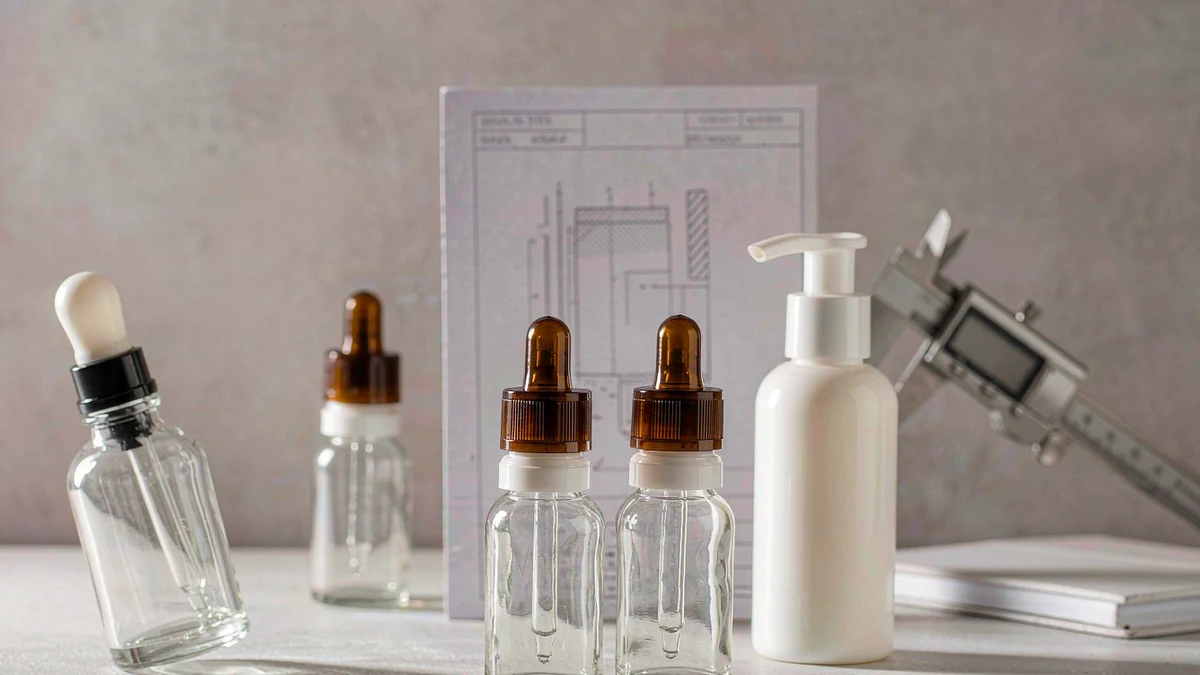
The neck-finish code is the starting point. The engineering drawing tells you what the parts actually look like.
Packaging drawings commonly use T, E, I, S and H.
T — Thread Diameter
T is the outside diameter measured across the threads. It is the dimension most closely related to the first number in a neck-finish code.
E — Neck Diameter Below the Thread
E is the outside diameter of the neck below the thread. It can affect skirt clearance, tamper-evident bands and other closure features.
I — Internal Diameter
I is the inside diameter of the opening. It matters for plug-style seals, inserts, flow and the space available around dip tubes or dispensing components.
S — Thread Start Position
S describes the position where the thread begins relative to the top of the bottle. It affects how the closure engages and reaches the sealing surface.
H — Neck Height
H describes neck height, but this is one area where supplier drawings can be misleading if they are compared without checking the measurement definition.
Published H values vary because some suppliers measure the whole neck, some measure only the threaded section, and others measure to a different resting point.
So do not approve a combination because two catalogues show a similar H number. Compare the drawings themselves and confirm that both suppliers are measuring from the same reference points.
5. How Droppers Match Bottle Necks
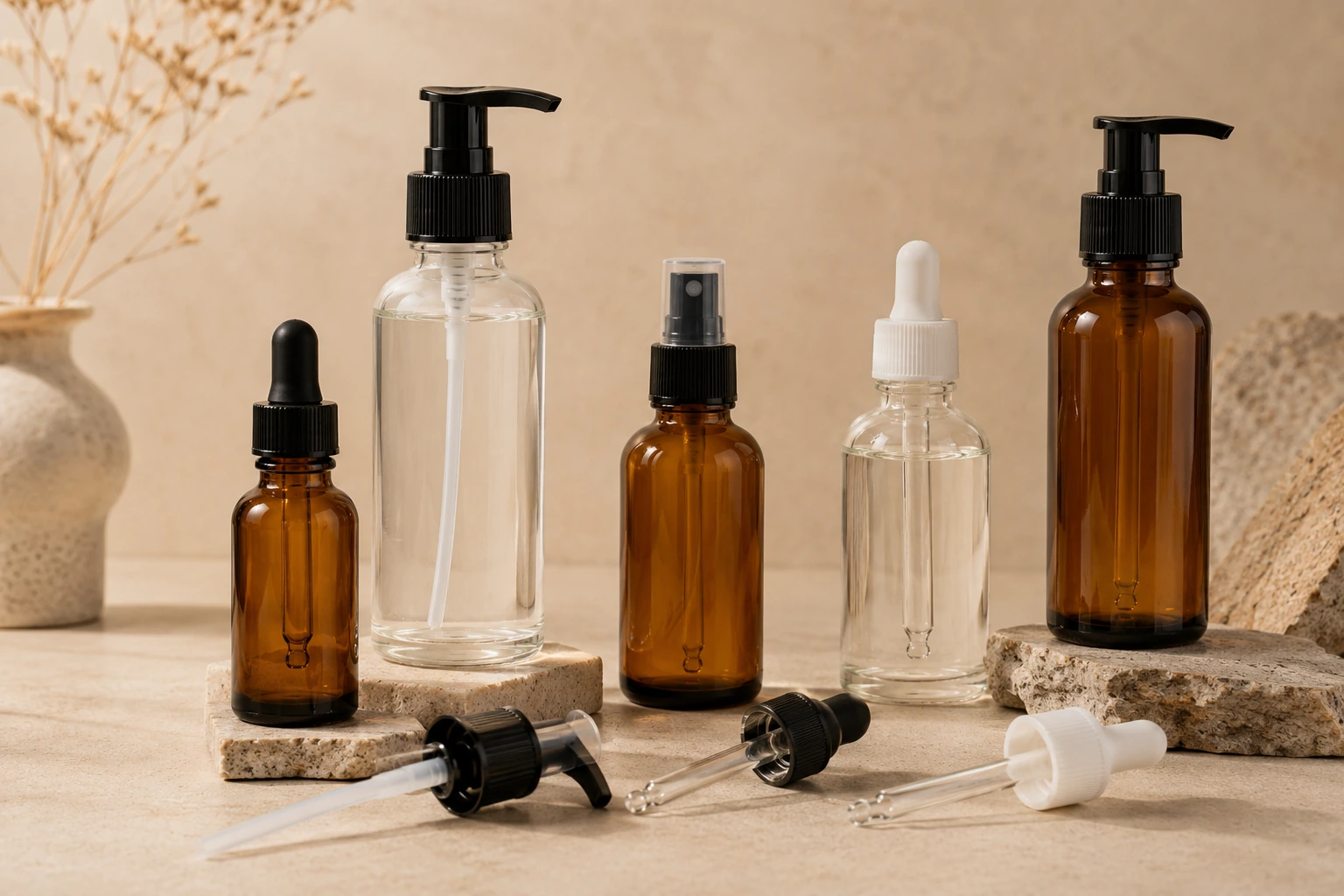
A dropper is a small assembly, not just a bulb and a piece of glass tubing.
The package normally includes the bulb, collar or screw closure, pipette, sealing surface or gasket, and the bottle neck itself.
Common dropper systems include 18/400, 18/415 and DIN18-type formats, among others.
The collar has to match the neck finish. The pipette then has to match the bottle height.
Venturove’s 30ml round glass dropper bottles show a typical skincare dropper format. The 5ml–100ml 18mm glass bottle platform is useful for seeing how one nominal neck diameter can be used across several bottle capacities.
That 18mm platform is listed as Bottle Only / Closure Not Included. Closure selection therefore remains a separate step. The exact 400/410/415-style finish for a Venturove item should not be inferred unless it has been confirmed for that specific product.
6. How Pumps Match Bottle Necks
A pump has to do two jobs at the same time: seal the bottle and dispense the formula consistently.
That adds more variables than a simple screw cap.
Treatment pumps and lotion pumps are commonly offered in finishes such as 20/410, 24/410 and 28/410, although the available options depend on the pump design and supplier.
Before approving a pump, check the full neck finish along with:
- closure skirt height;
- gasket or liner;
- spring and other formula-contact materials;
- pump output;
- dip-tube diameter;
- dip-tube length;
- recommended application torque.
Venturove’s amber square glass bottles with pump options show one example of a glass package designed around pump dispensing.
The product category alone should not be used to infer the exact thread finish, internal materials or supplied dip-tube length. Those details need to be confirmed for the selected configuration.
7. How Fine-Mist Sprayers and Caps Match
Fine-mist sprayers are commonly offered in finishes such as 18/410, 20/410 and 24/410.
Thread compatibility is only the first check. The dip tube also needs to reach close enough to the bottle base without being forced against it.
Venturove’s 30ml oval fine-mist glass spray bottle is an example of a small glass spray format.
Screw caps may look simpler, but the seal still depends on the neck finish and the closure design. Depending on the package, sealing can come from a liner, plug, flexible sealing lip, tamper-evident feature or induction liner.
A cap that fits the thread but does not create the intended seal is still the wrong cap.
8. Dip-Tube and Pipette Length Must Match Bottle Height
Thread compatibility does not solve tube length.
A dip tube or pipette that is too short leaves product behind. One that is too long can bend, press against the base, affect priming or make assembly difficult.
In practice, the tube usually needs to reach close to the bottom while leaving enough clearance to operate correctly.
Venturove’s 18mm bottle platform spans several capacities from 5ml to 100ml, with different bottle heights across the range. That is a good illustration of why one pipette length should not be assumed to fit every bottle in the family.
For more on how capacity changes packaging requirements, see Dropper Bottle Sizes Explained: 10ml, 15ml, 30ml and 50ml.
Some pump and sprayer dip tubes can be trimmed. Even then, the final cut length should be checked on the real bottle rather than estimated from a catalogue image.
9. The Gasket, Liner and Sealing Surface Matter
Threads hold the closure in place. They are not always the part that actually stops the liquid.
Depending on the design, the seal may be created by a liner pressed against the bottle land, a plug inside the opening, a flexible sealing lip, a gasket or another molded feature.
That makes the condition of the bottle land important. Scratches, chips, unevenness or contamination can create a leak path even when the thread match is correct.
The formula adds another layer.
Essential oils, alcohol-rich products, acids and other aggressive formulas can affect bulbs, liners, gaskets, springs and plastics. A package that behaves well with water may not behave the same way with the finished formula.
Compatibility testing should therefore use the intended formulation whenever possible.
10. Application Torque Is Part of Compatibility
A threaded closure also needs the right tightening force.
Too little torque can leave the gasket under-compressed or allow the closure to loosen in transport. Too much can damage threads, distort liners, crack the closure or damage a dispensing mechanism.
Published torque tables are useful as references, but they are not universal settings.
The correct range depends on the bottle, closure material, neck finish, liner, manufacturing tolerance and filling conditions.
Ask the closure supplier for the recommended application torque, then validate it on the actual bottle-and-closure combination.
11. Common Bottle-and-Closure Matching Mistakes
The most expensive errors are often basic specification errors rather than exotic engineering problems.
Buying by Diameter Only
“18mm dropper” is not a complete purchasing specification. The finish still needs to be identified.
Assuming 410 and 415 Are Interchangeable
Some suppliers describe limited cross-fit, while other sources report gaps, weak engagement and leakage. Treat that as a reason to test, not as permission to mix finishes.
Sourcing Bottle and Closure Separately Without Cross-Checking
When the bottle and pump come from different suppliers, compare both drawings before approving either component.
Using the Wrong Pipette or Dip-Tube Length
A perfectly matched thread can still produce poor dispensing if the tube is too long or too short.
Ignoring Formula Compatibility
Bulbs, liners, gaskets, springs and plastics can behave differently with oils, alcohol, acids or active ingredients than they do with water.
Ignoring the Sealing Surface
A chipped or uneven bottle land can leak even with the correct closure.
Treating “Bottle Only” as a Complete Package
Some bottle platforms do not include the closure. Check whether the pump, dropper, cap, liner and tube are actually included in the quotation.
12. B2B Sourcing Checklist
Before approving a bottle-and-closure combination, make sure the technical conversation covers all of the following:
- Complete neck-finish code for the bottle.
- Complete neck-finish code for the closure.
- Confirmation that the two specifications match.
- T, E, I, S and H dimensions shown on comparable drawings.
- Manufacturing tolerances.
- Closure skirt height relative to the bottle neck.
- The sealing method used by the closure.
- Condition and geometry of the bottle land.
- Liner or gasket material in contact with the formula.
- Compatibility of the bulb, liner, gasket, spring and other contact materials.
- Recommended application torque.
- Dip-tube or pipette length.
- Pump output, where applicable.
- Inversion or upside-down leakage testing on the filled package.
- Vibration or transport testing.
- Compatibility testing with the real formula.
- Production-equivalent bottle and closure samples before final approval.
13. Test Before Production
A bottle and closure should be approved as one packaging system.
The exact test program depends on the product, but a sensible validation process normally checks dimensional fit, application torque, leakage under inversion, vibration or transport exposure, dip-tube or pipette performance, and formula compatibility.
That work is more useful than relying on a closure that “seems to fit” during a quick hand test.
Final Recommendation
When buying bottles, pumps, droppers, sprayers or caps, the nominal diameter is only the first filter.
An 18mm bottle is not automatically compatible with every 18mm closure, and a 24mm bottle is not automatically compatible with every 24mm pump.
The practical sequence is to confirm the full neck finish, compare the drawings, verify the sealing system, size the pipette or dip tube correctly and then test the filled package under realistic conditions.
For a skincare packaging project, the decision path usually looks like this:
formula → dispensing format → bottle capacity → bottle material → neck finish → closure → compatibility testing.
For the broader selection process, review How to Choose the Right Cosmetic Packaging for Your Beauty Product.
Need Help Matching a Bottle and Closure?
Share your bottle capacity, dispensing type, formula and closure requirements with Venturove. We can help you compare suitable packaging configurations for your project.
FAQ
What does 24/410 mean on a cosmetic bottle?
The first number refers to the nominal thread diameter, about 24mm. The second number is a neck-finish style code, not a 410mm measurement.
Can I use an 18/410 dropper on an 18/415 bottle?
Do not assume that it will work. Both use an 18mm nominal diameter, but the finish geometry is different. Because supplier guidance on limited cross-compatibility is inconsistent, the safer approach is to match the full finish and test the actual components.
Are 24/400 and 24/410 interchangeable?
They should not be treated as interchangeable. The nominal diameter is the same, but the neck finishes are different. Use a closure specified for the bottle’s exact finish.
What is the difference between 410 and 415 neck finishes?
Industry references generally describe 415 as a longer finish with more thread engagement than 410. Exact dimensions vary by manufacturer and by how the drawing is measured, so the supplier drawing should take priority over a generic height figure.
How do I know what pump fits my cosmetic bottle?
Start with the bottle’s complete neck-finish specification and choose a pump designed for that finish. Then confirm the skirt height, gasket or liner, dip-tube length, pump output and recommended torque.
Can I cut a pump dip tube to fit a shorter bottle?
Many dip tubes can be trimmed. The finished length still needs to be checked on the real bottle: too short leaves product behind, while too long can interfere with priming or press against the base.
Why does a bottle leak even when the cap screws on?
A cap can screw on and still fail to seal. Common causes include a mismatched neck finish, incorrect torque, a damaged sealing surface, an unsuitable liner or gasket, dimensional variation, or loosening during transport.