
Glass Cream Jars vs Plastic Cream Jars: Which Is Right for Your Formula?

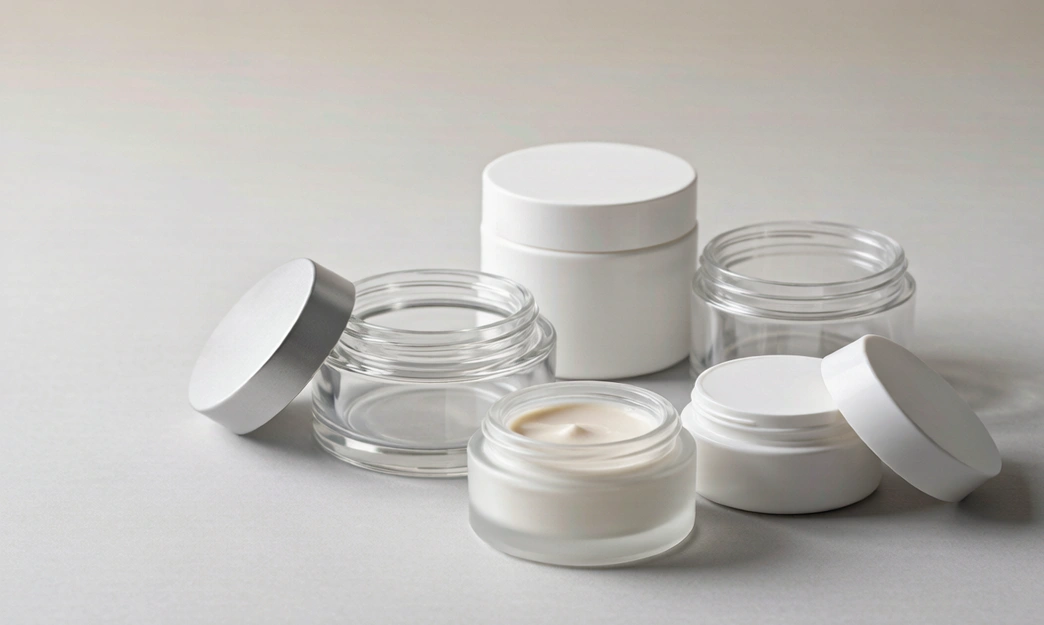
Most jar decisions get made backwards. A founder picks the jar that photographs well, sends the artwork, approves the sample, and only discovers eight months later that the cream has gone grainy, the lid has hazed, or one in twenty units arrives cracked. The material was never the first question. The jar format was.
A jar is the least protective packaging format in common cosmetic use. Wide mouth, large headspace, fingers going in, lid coming off twice a day for six months. That is a hard brief for any formula. Choosing between glass and plastic only makes sense once you accept what the format itself already costs you, because the right material is the one that compensates for the jar’s weaknesses in your specific formula and your specific sales channel.
So the real question is not glass versus plastic cream jars in the abstract. It is which material compensates best for the jar format, given your chemistry, your price point and your channel. What follows is the version you want before you send quote requests out: what glass actually buys you, where PP quietly wins, what PET and acrylic are for, and which lines belong in your RFQ so the numbers coming back are comparable.
What a jar costs you before material enters the conversation
Three things happen in a jar that do not happen in a tube or an airless pump.
The whole surface meets air, every time. Unscrew the lid and the entire product face is exposed. For antioxidant-heavy or retinoid formulas this matters more than most brands assume, and it is cumulative across the product’s life on a bathroom shelf.
Fingers go in. Not occasionally. Every use. That introduces skin flora and whatever else was on the hand, and it does so into a warm, humid, closed container. A spatula helps and does not solve it.
Your preservative system carries the load. This is the part that catches out clean-beauty positioning. A minimal preservative blend at low concentration can perform beautifully in an airless pump and struggle in an open jar. If your formulator has built a lean preservative system, tell them the format before they finalise it, not after.
None of this makes jars a mistake. Thick balms, body butters, occlusive night creams and anything the customer wants to scoop genuinely belong in a jar, and consumers still read a heavy jar as a serious product. It does mean the material choice is a mitigation decision, not a styling decision. If your actives are fragile enough that the above list worries you, the honest answer might be a different format entirely rather than a different jar material, and our comparison of dropper, pump and airless formats covers that trade-off.
Glass jars: inert, heavy, and expensive to ship broken
Glass is chemically inert. It does not react with retinol, L-ascorbic acid, AHAs, or oil-rich and essential-oil-rich formulas, and it does not absorb fragrance. For a formulator, that removes an entire category of unknowns: whatever goes wrong with the product, the container did not cause it. Nothing else on this list gives you that.
Add amber or an opaque coating and you get UV protection as well, which is why light-sensitive actives keep ending up in coloured glass. We have covered the amber versus clear question in detail; the short version is that clear glass protects your chemistry from the container but not from the shop lighting.
The cost is physical. A 30 g glass jar can weigh four to five times its plastic equivalent, and that weight travels with every unit you ship, twice if you are stocking a warehouse before fulfilling to customers. Breakage is the bigger issue. Every source in the industry agrees glass breaks materially more often in transit than plastic does; the published rates vary widely enough that you should not plan around any single figure, but the difference is large enough to change your returns maths and, on a DTC channel, your review scores.
Glass earns its place when the price point absorbs the freight, when the formula is genuinely sensitive, or when the jar is a hero SKU whose unboxing does marketing work. It struggles in high-volume, low-margin, e-commerce-first lines.
PP: the unglamorous answer that is usually correct
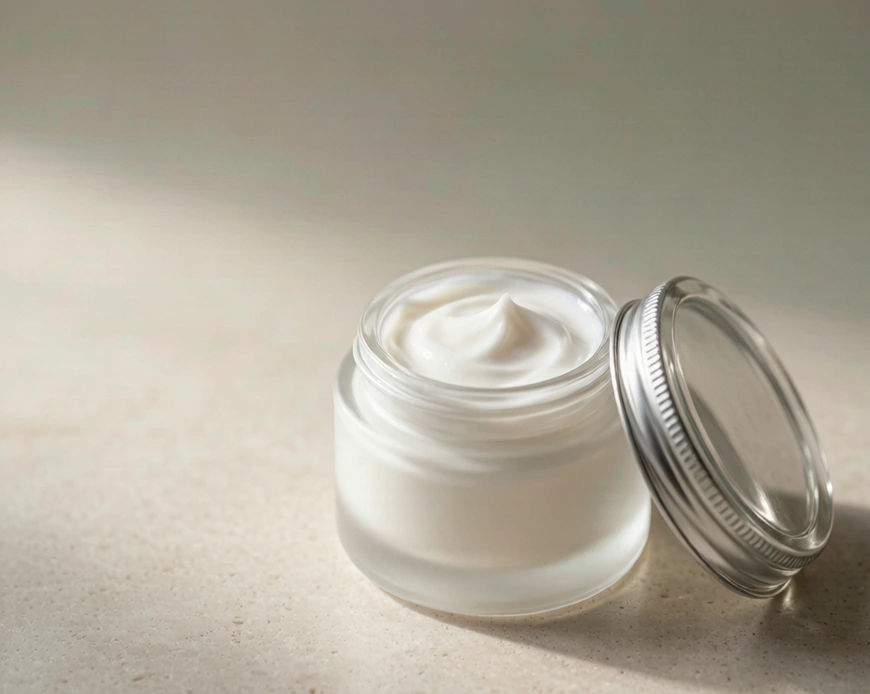
Polypropylene has the widest chemical compatibility of the common jar plastics. Acids, alkalis, oils, alcohols, most surfactant systems: PP handles them. It also tolerates heat well enough for hot-fill and for autoclaving, which PET does not.
It is light, it is cheap, it survives being dropped on a tiled bathroom floor, and it is collected in most kerbside recycling streams as resin #5. For everyday moisturisers, body butters, hair masks, cleansing balms and anything high-viscosity and oil-heavy, PP is the default for a reason.
The objection is always the same: it does not look premium. Natural PP is translucent-to-opaque and reads as functional. That is fixable more cheaply than most brands expect. A soft-touch matte finish, a weighted double-wall construction, a decorated lid, and the jar stops looking like a sample pot. Post-consumer recycled PP also lets you keep a credible sustainability line without moving to glass, and the decoration options available on plastic are broader than on glass in several respects.
If you are undecided and your formula is not exotic, start your quotes with PP. It is the baseline everything else gets compared against.
PET: glass-like clarity, plastic weight
PET is water-clear. If the product itself is the visual, a pale pink balm, a translucent gel-cream, a coloured whipped texture, PET lets the formula sell itself and you can cut back on label coverage. It is also the most widely recycled plastic globally, which makes the recyclability conversation straightforward.
Two limits to hold in mind. PET is less tolerant than PP of strongly acidic or strongly alkaline systems and of high alcohol content over long storage, so anything unusual needs a compatibility check. And PET does not like hot-fill; if your process fills warm, ask before you commit. Reports on cold-weather brittleness vary, so if you ship into cold climates in winter, raise it with the supplier and ask what they have seen rather than assuming either way.
PET typically prices above PP and below acrylic. It is the sensible middle when clarity matters and glass does not fit the channel.
Acrylic: the premium feel with a narrow chemistry window
Acrylic (PMMA) is the material behind most double-wall “floating product” jars. Optical clarity is the highest of any plastic here, surface hardness is good, and a thick-walled acrylic jar has a hand-feel close enough to glass that customers frequently keep the empties. That is the case for it, and it is a real one.
The case against is chemistry and end-of-life. High-alcohol formulas, strong solvents and heavy essential-oil loads can cause crazing, a network of surface micro-cracks, or make the wall cloudy or brittle over months. This is not a rare edge case; it is the standard acrylic failure mode, and it appears after the product has shipped. Compatibility testing on acrylic is not advisable, it is mandatory. Acrylic also carries resin code #7 and is generally not accepted in household recycling, so it cannot support a strong recyclability claim.
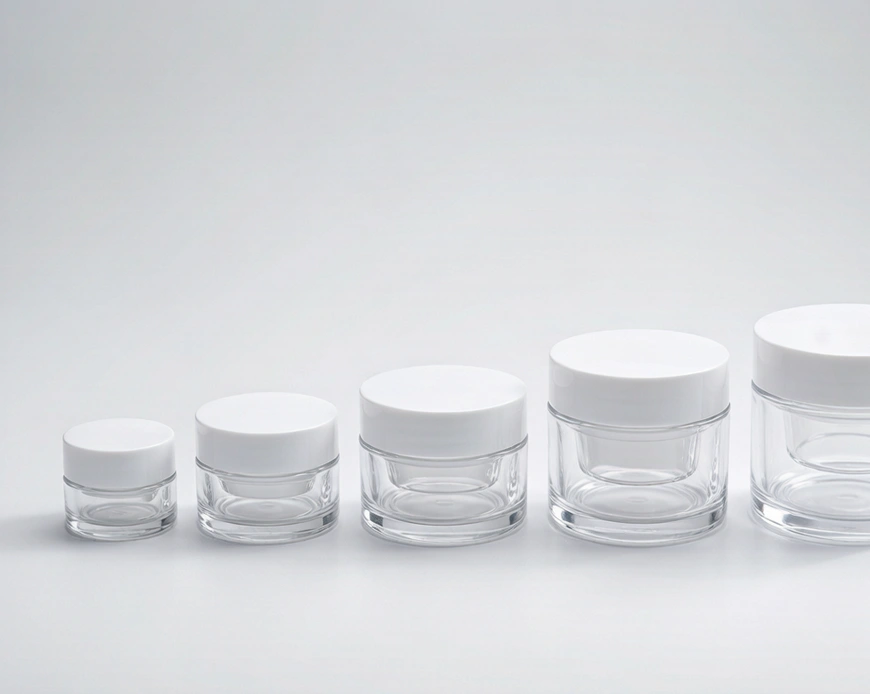
One detail worth knowing before you read any double-wall quote: a double-wall jar is two separate parts, an outer decorative shell and an inner cup, with an air gap between them. It is not a thick single wall. The inner cup that touches your formula is usually moulded in food-grade PP whatever the outer shell is made of. So a “glass-look acrylic jar” may in practice be a PP-contact jar with an acrylic shell, which changes your compatibility question entirely. Ask which layer touches the product and get it in writing.
Matching material to formula
| Formula type | First choice | Workable | Avoid without testing |
|---|---|---|---|
| Retinoid or high-dose vitamin C cream | Amber or opaque glass | PP, opaque | Clear anything; acrylic |
| Oil-heavy balm, body butter, cleansing balm | PP | Glass | Acrylic |
| Essential-oil-rich or fragrance-heavy cream | Glass | PP | Acrylic, PET |
| Water-based day cream, gel-cream | PP or PET | Acrylic, glass | — |
| High-alcohol or solvent-containing formula | Glass | PP | Acrylic, PET |
| Hot-filled product | PP or glass | — | PET, acrylic |
| Whipped or high-viscosity texture at accessible price | PP or PCR-PP | PET | — |
| Prestige eye cream, countertop hero SKU | Glass or double-wall acrylic | PET | — |
Treat the table as a starting position for your RFQ, not a substitute for testing. Our guide to compatibility and stability testing sets out what to run and how long to run it for.
Matching material to channel and price tier
Formula narrows the field. Channel usually picks the winner.
DTC and marketplace-first. Breakage stops being only a cost and becomes a review problem, since one cracked jar costs you a refund, a replacement and a rating. Plastic or acrylic protects the P&L here, and glass is best reserved for a limited hero SKU or a refillable outer shell.
Retail and boutique. Shelf presence pays for itself. Glass and thick-walled acrylic both justify their price when the customer picks the jar up before deciding.
Salon, spa and professional. Larger sizes, opened many times a day, wet environments, staff handling. PP wins on durability and cost, and nobody in a treatment room is judging the jar.
Refill programmes. The practical compromise at the moment is a durable glass or acrylic outer paired with a replaceable inner pod, which keeps the premium jar without shipping heavy glass on repeat.
Price tier matters mostly through freight. A jar that adds fifty grams to every unit is invisible at a premium price and fatal at an accessible one.
What to put in the RFQ so the quotes are comparable
Quotes for “a 50 g cream jar” come back non-comparable almost every time. Specify these and they stop.
- Capacity, and whether you mean fill volume or brimful volume
- Material, by resin name and grade, for both the outer shell and the product-contact layer
- Single wall or double wall, plus overall wall thickness
- Neck finish, thread size and closure type
- Liner disc or gasket, with material stated
- Lid material and decoration method
- Colour, finish and any coating
- Unit weight, since freight modelling needs it
- Compatibility or stability data the supplier already holds for similar formulas
- Drop test and leak test results, if they exist
- Recyclability position by resin code, stated honestly
- Quantity tiers, so the price break structure is visible
The last point deserves emphasis. Quantity changes which material is even available to you, since tooling-dependent options have very different entry points from stock shapes. If that is unfamiliar territory, our explainer on how packaging MOQs work covers why the same jar can carry three different minimums.
If you want the wider brand-level view of the material argument beyond jars, our earlier post on glass versus plastic cosmetic packaging takes it across formats.
Need help choosing the right cream jar?
Tell us your formula, capacity and target price point, and we will come back with jar options, material recommendations and quantity tiers.
FAQ
Is glass always better for active ingredients than plastic?
For chemical inertness, yes, glass removes the compatibility question entirely. But a clear glass jar offers no light protection, and a jar of any material still exposes the full product surface to air at every use. If your actives are fragile, opaque glass or a lower-air-exposure format will do more for you than glass alone.
Can I use acrylic jars for a facial oil or balm with essential oils?
Not without testing, and often not at all. Essential oils and solvents are the classic cause of crazing in acrylic. If the aesthetic is non-negotiable, look at a double-wall build where the product-contact inner cup is PP and confirm in writing which layer touches the formula.
Which is cheaper to ship, and how much difference does it make?
Plastic, clearly. A glass jar can weigh several times its plastic equivalent, and breakage adds replacement and return costs on top of freight. Published breakage figures vary widely between sources, so model it with your own carrier and channel data rather than an industry average.
What is the difference between a double-wall jar and a thick-wall jar?
A double-wall jar has two separate parts with an air gap between them, which is what creates the floating look and the insulating effect. A thick-wall jar is one heavier moulded piece. They look similar on a spec sheet and behave differently on weight, cost and compatibility.
Do I still need compatibility testing if I choose PP?
PP has the widest tolerance of the common jar plastics, so the risk is lower. It is not zero. Unusual actives, high fragrance loads, extreme pH and long shelf-life claims all justify a stability run before you commit to a production quantity.
Can plastic jars look premium enough for a higher price point?
Yes, and more cheaply than most brands expect. Double-wall construction adds perceived weight, matte or soft-touch finishes change the hand-feel, and a decorated or weighted lid does a lot of work. The gap between a well-finished plastic jar and a plain glass one is smaller than the price difference suggests.